
Passive euthanasia: How Harish Rana’s case revived memories for Aruna Shanbaug’s long, silent fight for dignity in death | India News
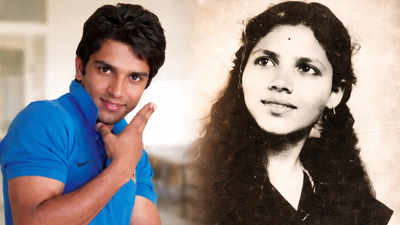
Harish Rana (L) and Aruna Shanbaug (R)
NEW DELHI: “To be, or not to be: that is the question,” William Shakespeare’s famous soliloquy aptly captures the tragic dilemma surrounding Harish Rana’s life and death, who has struggled for over a decade in a vegetative condition. Invoking the Shakespearean tragedy of Hamlet, the Supreme Court announced a historic verdict allowing passive euthanasia for the young man from Ghaziabad.
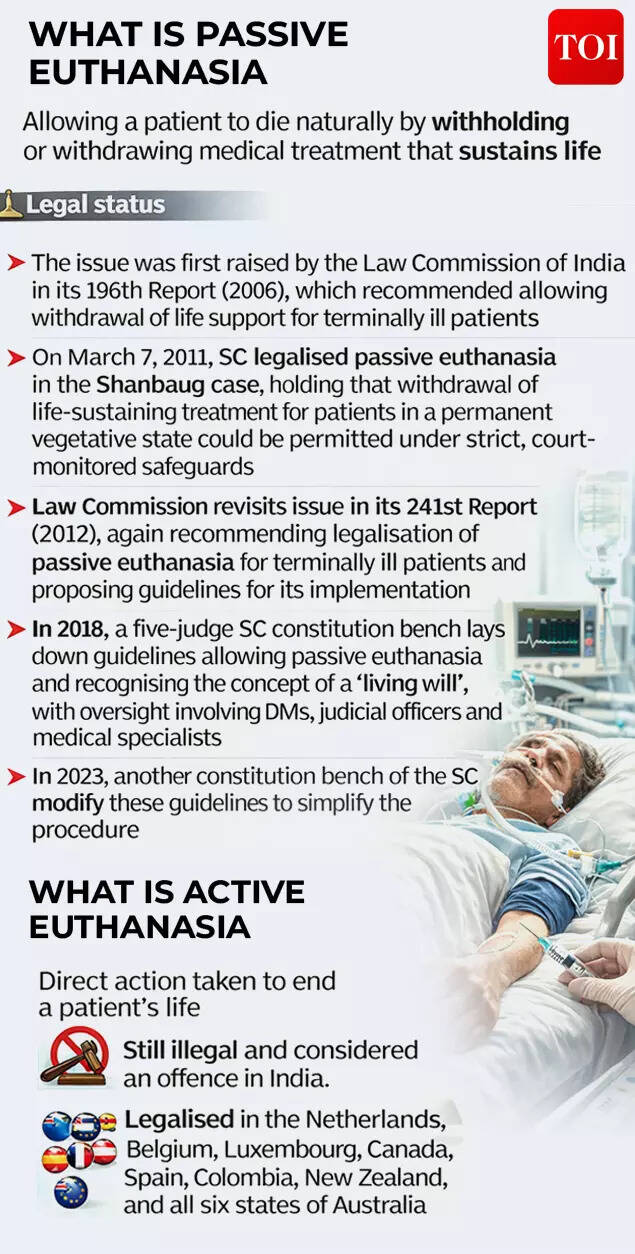
The top court granted the first-ever approval of passive euthanasia in such a case, permitting the withdrawal of medical treatment and life support for the 32-year-old, who has remained between the thin line of life and death for over 13 years due to irreversible and non-progressive brain damage. The decision effectively paves the way for nature to take its course, while bringing an end to the prolonged agony of parents who have endured the pain of witnessing their son’s suffering every day.
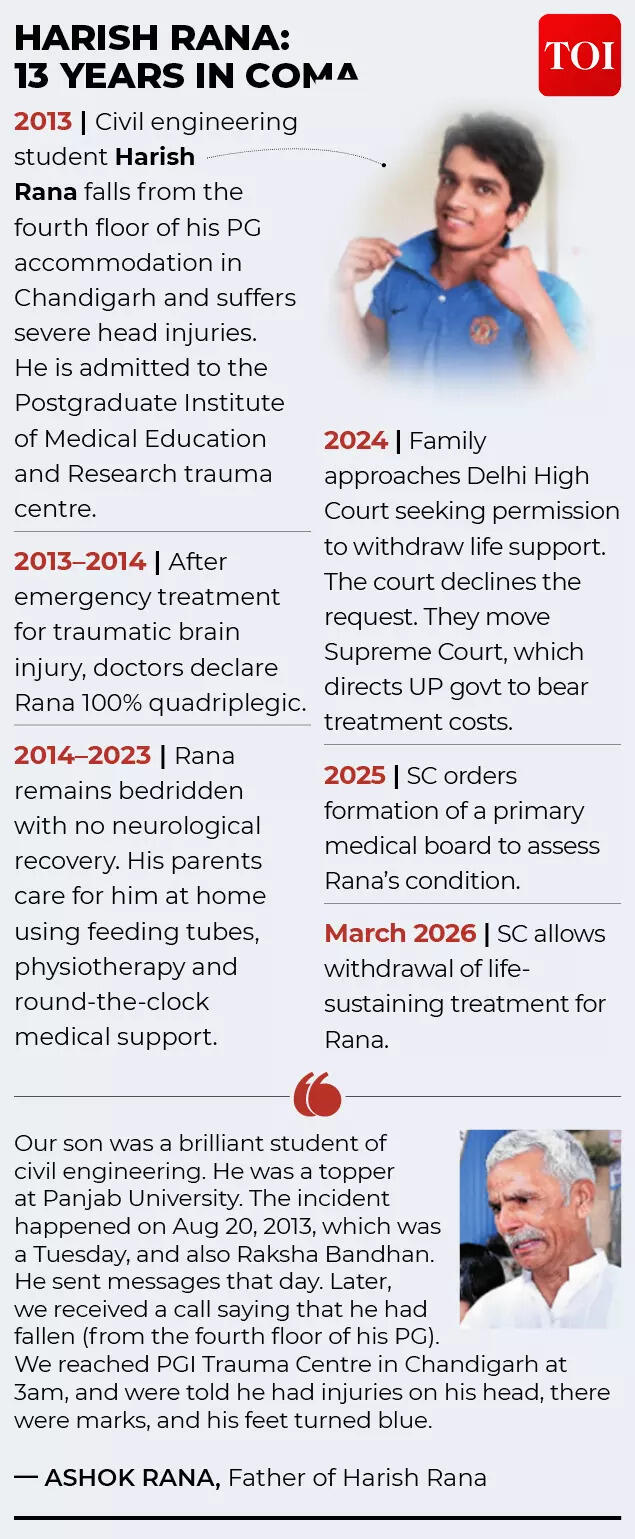
The “difficult decision” came from a bench of Justices JB Pardiwala and KV Viswanathan, based on the recommendations of two medical boards, as per the amended Euthanasia framework of 2018, and after personally interacting with Harish’s parents. The judgment observed that the continuation of medical treatment was no longer in the patient’s best interest.With its first verdict of this kind, the court granted Harish Rana the possibility of a “dignified death,” allowing him to exercise the “right to die with dignity”, a choice that Aruna Shanbaug had sought but never received during the four decades she spent suspended between life and death.
From Ghalib to Constitution: The legal journey of euthanasia in India
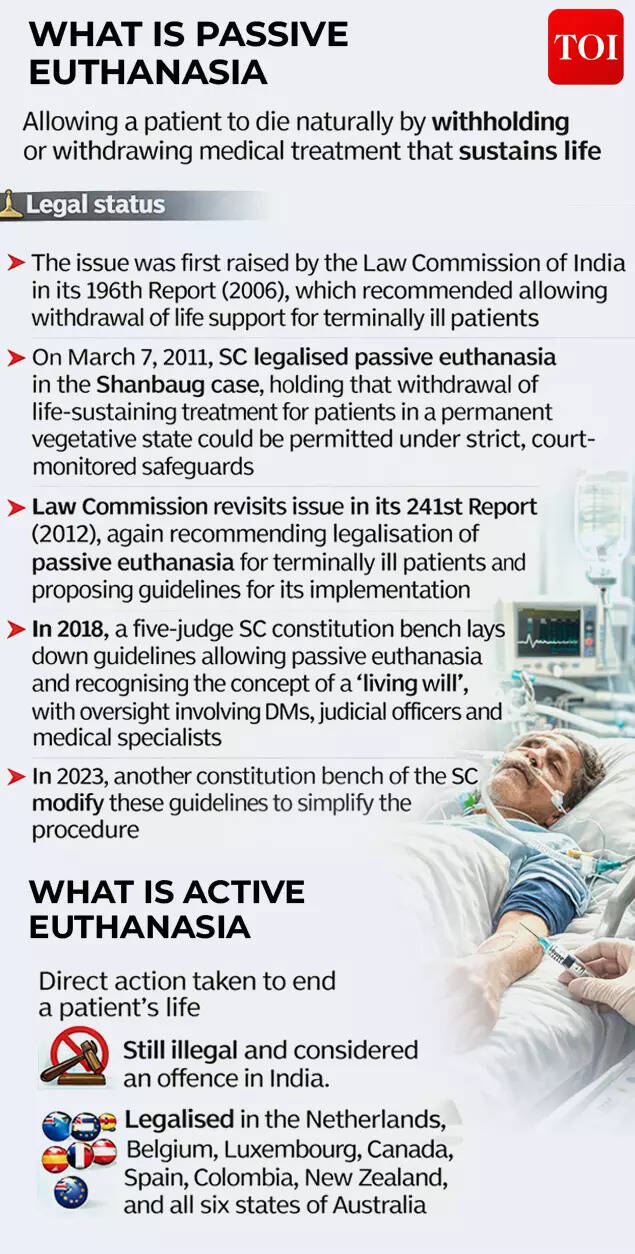
When the Supreme Court heard Shanbaug’s case in 2011, it turned to the existential lines of Mirza Ghalib: “Marte hain aarzoo mein marne ki, maut aati hai par nahin aati.” loosely translated as, “We perish with the wish to die; death approaches, yet never arrives.”In that landmark ruling, the topmost court laid down the legal framework permitting passive euthanasia in India, later detailed procedural guidelines established in 2018. Years later, that precedent has now found its first full expression in the case of Harish Rana, turning a long-debated principle into a lived judicial decision.In its Wednesday verdict, the court also directed AIIMS Delhi to admit Harish Rana to its palliative care centre and initiate steps for the withdrawal or withholding of medical treatment. At the same time, the bench underlined that such a decision must not translate into neglect. “The resultant effect must not be the abandonment of the patient,” it observed.
Separated by more than a decade, the cases of Aruna Shanbaug and Harish Rana together add deeper meaning to the evolving role of India’s judiciary and the expectations placed upon it.When life recedes and death refuses to arrive, when consciousness fades and existence is confined to a hospital bed, the question of dignity becomes unavoidable.As Friedrich Nietzsche once wrote, “He who has a why to live can bear almost any how.” The court’s decision, in many ways, confronts the painful reality of what remains when that “why” disappears.
Harish Rana: A life halted, a family’s long wait
Tragedy struck Harish Rana when he was just 20, a bright engineering student at Panjab University with a promising future ahead. In August 2013, during the final semester of his BTech in civil engineering, a fall from the fourth floor of his paying guest accommodation in Punjab’s Kharar changed everything.The accident left him with severe brain injuries, including diffuse axonal injury, a devastating form of traumatic brain damage, and resulted in complete quadriplegia. Despite treatment at leading institutions such as PGI Chandigarh, AIIMS Delhi, Ram Manohar Lohia Hospital and Lok Nayak Hospital, Harish never recovered. He has remained in a permanent vegetative state since the fall, bedridden and entirely dependent on life support.He can open his eyes and blink, but there is no awareness, no response to sound, touch, voice or pain.Years of immobility have left him with severe bedsores, adding to his suffering.For his family, the passage of time has only deepened the pain.
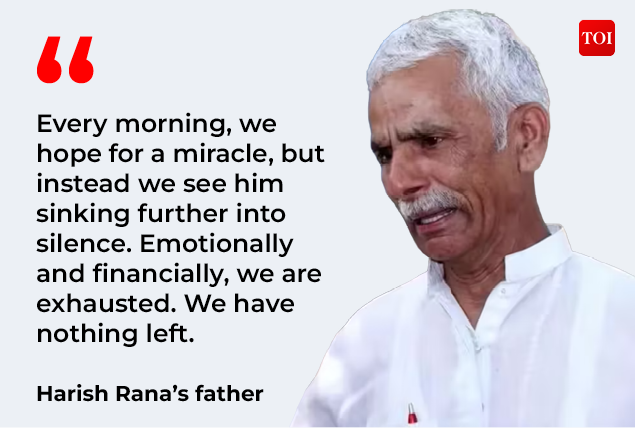
“How does it feel to see your own child lying in bed for years, without any eye contact, any communication or movement?” asked his father, Ashok Rana, his voice breaking months ago in 2025. “Every morning, we hope for a miracle, but instead we see him sinking further into silence. Emotionally and financially, we are exhausted. We have nothing left.”Pausing to steady himself, he added, “When I look into his eyes, there is nothing, no recognition. He cannot even turn his head. As parents, it is unbearable. We cannot see him like this anymore.”The memories of who Harish once was remain vivid.“Our son was a brilliant student. He was a topper in civil engineering at the university. The incident happened on Aug 20, 2013, which was a Tuesday and also Raksha Bandhan. He had sent us messages. Later in the day, we received a call saying he had fallen. When we reached the PGI trauma centre at 3am, he had injuries on his head and his feet had turned blue,” Ashok said.His brother, Ashish Rana, recalled how the family clung to hope for years. “We kept believing he would wake up someday, talk again, walk again,” he said.But hope came at a heavy cost.The family said they were forced to sell their home in Dwarka to continue his treatment. Monthly medical expenses alone run between Rs 24,000 and Rs 30,000, covering tubes, medicines and life-support equipment.
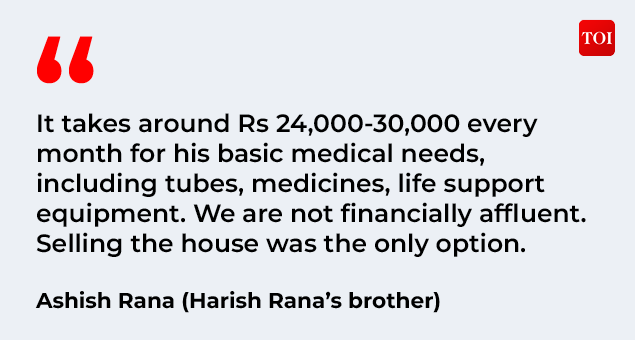
“It takes around Rs 24,000-30,000 every month for his basic medical needs, including tubes, medicines, life support equipment. We are not financially affluent. Selling the house was the only option,” Ashish said.For the Ranas, their plea was never about giving up, it was about dignity.“We just want him to be at peace,” his father said quietly. “No child deserves to suffer like this, and no parent deserves to watch it.”
What court said: ‘Best interest’ and right to dignity
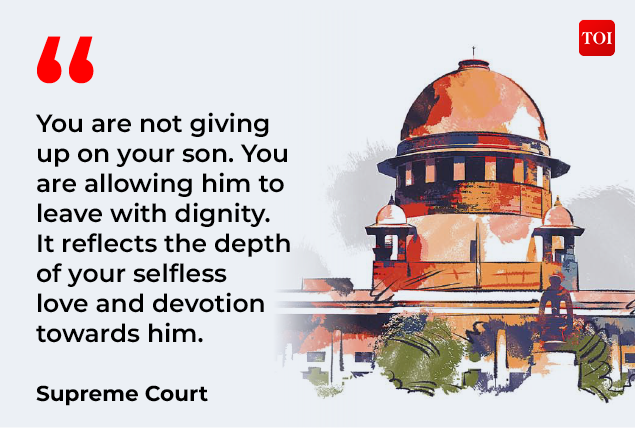
The top court’s landmark ruling permitting passive euthanasia for the first-ever time has brought renewed focus to a critical legal doctrine, the “best interest of the patient.”The decision by the two-judge bench described it as the delicate intersection of “love, loss, medicine and mercy”.“You are not giving up on your son. You are allowing him to leave with dignity. It reflects the depth of your selfless love and devotion towards him,” the Supreme Court told the parents.
At the heart of the ruling was the case of 32-year-old Harish Rana, who had remained in a persistent vegetative state for nearly 13 years, with irreversible and non-progressive brain damage. Applying the “best interest” principle, the court permitted passive euthanasia, allowing the withdrawal of all life-sustaining treatment, including ventilators and feeding tubes.In doing so, the bench undertook an extensive examination of the doctrine, drawing from the landmark 2018 Constitution Bench ruling in Common Cause vs Union of India, as well as international practices on end-of-life decision-making.On January 24, 2023, a Constitution bench eased the 2018 passive euthanasia guidelines, mandating primary and secondary medical boards to approve withdrawal of life support for patients in a vegetative state.This marks the first time the apex court has applied its own 2018 guidelines on passive euthanasia in a specific case.“The famous literary Shakespeare quote ‘To be or not to be’ is now being used for judicially interpreting the ‘Right to Die,” Justice Pardiwala noted at the beginning of the judgment.The bench described its decision as a “difficult” one, taken after relying on reports from two medical boards, which had approved the withdrawal of life support after personally interacting with Rana’s parents.It concluded that the continuation of medical treatment was not in his “best interest”.The court directed AIIMS Delhi to admit Rana to its palliative care centre and initiate the process of withdrawing or withholding treatment, while specifying that “the resultant effect must not be the abandonment of the patient”.“Due focus must be given to the comfort of the patient through pain and symptom management,” the court said.Reaffirming constitutional principles, the bench described dignity as the most sacred possession of a human being. It held that the right to live with dignity under Article 21 inherently includes the right to die with dignity.“Temporarily keeping alive a terminally ill patient who is brain dead or in PVS (persistent vegetative state), solely because doctors are able to leverage the technological advancements in medicine, and compelling such patients to endure a slow, agonising death, cannot fully be compatible with the constitutional ideal of dignity. There would arise a point of precipice where such prolonged medical treatment would stand as an affront to basic human dignity,” the bench said.
Aruna Shanbaug: The case that began it all
November 27, 1973.Decades before Harish Rana’s birth, a young nurse’s routine night shift in Bombay would turn into one of India’s most haunting medical-legal cases. Aruna Shanbaug, just 26, had spent the day caring for patients at King Edward Memorial Hospital, unaware that the night ahead would alter the course of her life, and the country’s legal history, forever.“November 27, 1973. Aruna Shanbaug, 26, is almost at the end of a tiring day. As nurse at Bombay’s King Edward Memorial Hospital, she’s been busy dealing with adulterated mithai poisoning cases, particularly children. It’s far too late to go home; she will spend the night at the nurses’ quarters…At last it’s time for bed. Aruna Shanbaug walks towards the cardio-vascular thoracic centre (CVTC) in the basement for her purse. That’s the last time in her life she walks. Or talks.
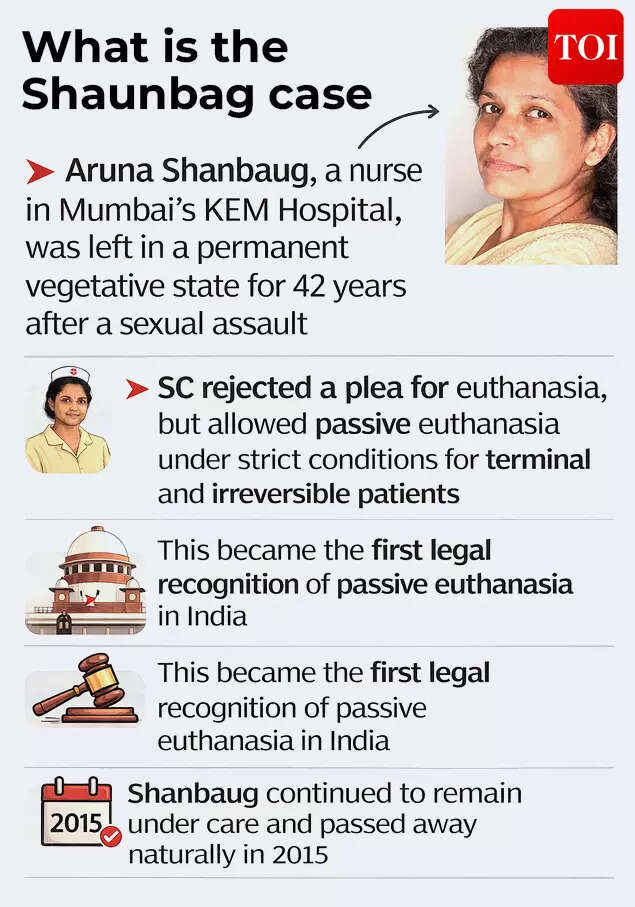
…At around eight the next morning, Matron Belimal gets frantic messages. A sweeper went to the CVTC and saw a woman with white clothes torn and thrown all around her. She has been identified as nurse Aruna Shanbaug. And there is a dog’s chain around her neck,” euthanasia activist and journalist Pinki Virani recounted.That night changed everything.A young nurse known among colleagues for her spirited personality and warmth, Shanbaug had been preparing to change from her uniform into a rose-pink sari to meet her fiancé, a doctor. Instead, she was brutally attacked in the hospital basement by sweeper Sohanlal Bharta Walmiki.She was discovered nearly 11 hours later, her heart still beating. But survival came at a devastating cost.The lack of oxygen had caused severe and irreversible brain damage. Shanbaug slipped into a persistent vegetative state, conscious only of pain, unable to speak, move or communicate.
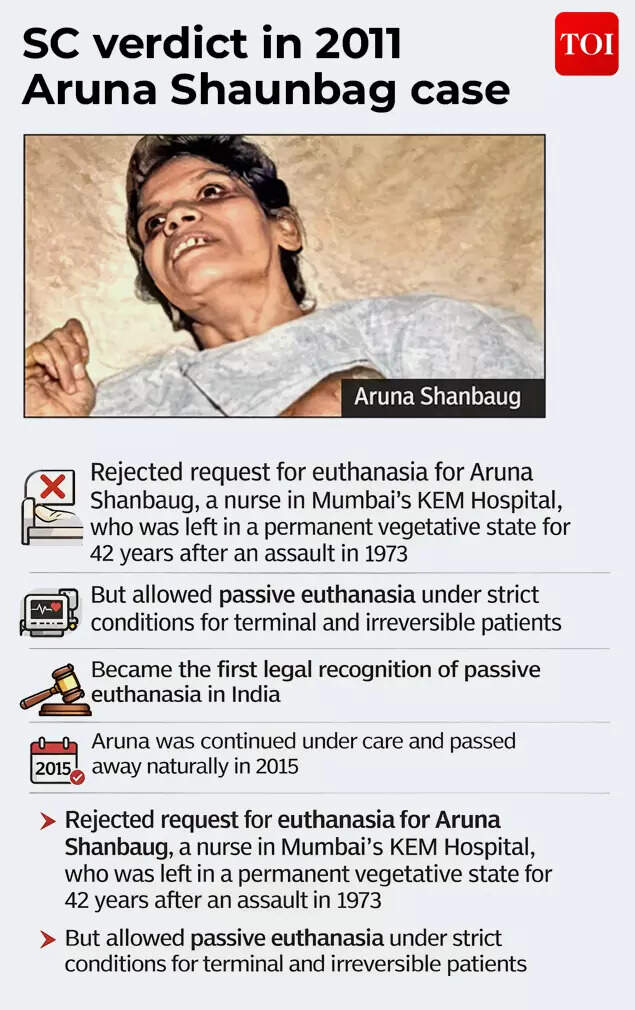
SC verdict in 2011 on Aruna Shanbaug’s case
His freedom stood in stark contrast to Shanbaug’s condition.Confined to a hospital bed at KEM, she remained in a vegetative state for decades.Ultimately, despite laying the foundation of legal framework for passive euthanasia under strict conditions, the topp court denied Aruna Shanbaug the ‘right to die.’In the end, Aruna Shanbaug’s case laid the foundation. Years later, that legal pathway would finally be invoked in the case of Harish Rana.
But as a nation, we must remember that we gave her nothing. We let Aruna down.
Pinki Virani
For decades, Aruna Shanbaug lay silent in a hospital ward, her story a haunting reminder of violence, neglect and the long struggle for dignity in life and death.
‘To be, or not to be’ finds an answer
Meanwhile, the long agony of Harish Rana and his family edges toward an end that resists the binaries of joy or grief.At Delhi’s AIIMS, doctors have initiated the protocol for passive euthanasia following the top court’s order, a process expected to implement over the next two to three weeks, officials told PTI.In a video that has circulated widely, the young man from Ghaziabad lies still, eyes open yet distant, as relatives gather in quiet prayer.A member of the Brahma Kumaris based in Mount Abu, gently places a tilak on his forehead and whispers, “Sabko maaf karte hue, sabse maafi mangte hue, so jaao theek hai… (Forgiving everyone and asking forgiveness from everyone. Now sleep. It’s okay).”A struggle that spanned more than a decade has now reached a form of closure. As John Keats once wrote, “Half in love with easeful death,” the line lingers over Rana’s final passage.Through a legal path first carved in the case of Aruna Shanbaug, he has been granted what she never was.In that quiet, difficult distinction lies the weight of both justice, and time.